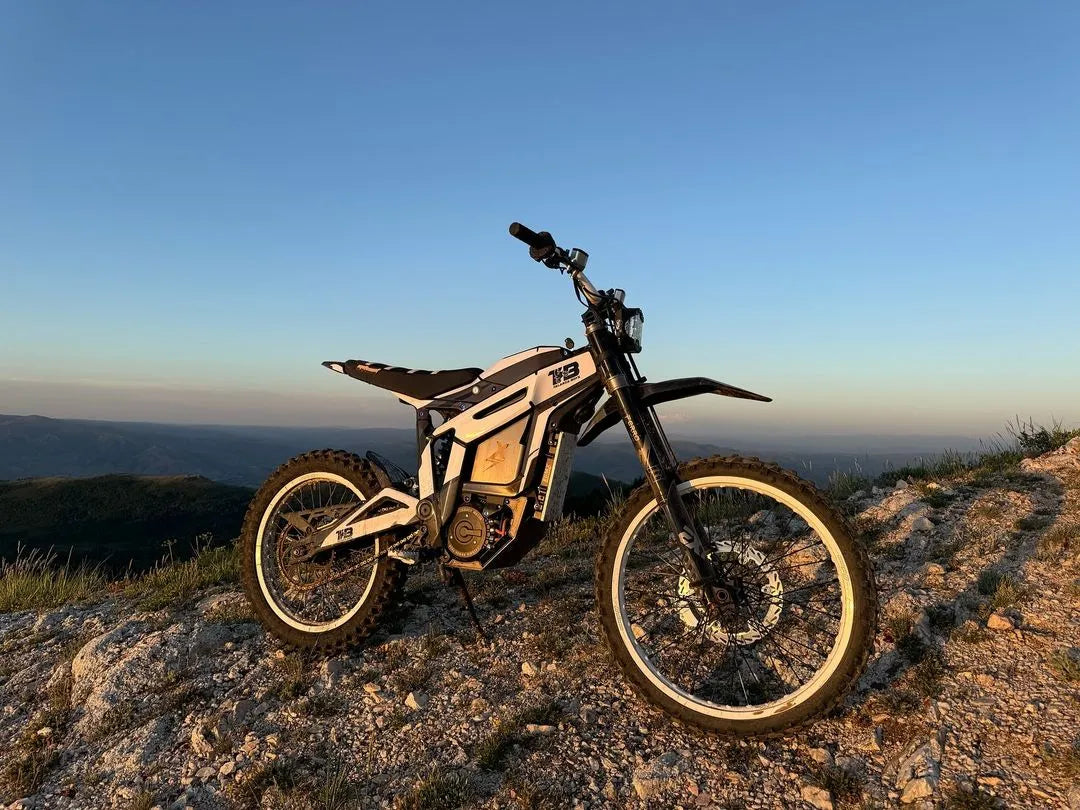
Ten years ago, an electric dirt bike was a curiosity. Today, e-motos are all over trails, tracks and private land, and some of them out-accelerate the gas bikes they replaced. Here's a quick look at how electric motorcycles got here, and where the off-road side is now.
What Is an E-Moto?
"E-moto" is short for electric motorcycle. Instead of an engine, gas tank and transmission, you get a battery, a controller and an electric motor. What that means on the trail:
- Instant torque: full pull from zero rpm, with no clutch or shifting.
- Less maintenance: no oil changes, air filters or spark plugs.
- Quiet: you hear the tires and chain, not an exhaust. That keeps neighbors and landowners happier.
- No tailpipe emissions.
Don't confuse e-motos with pedal-assist e-bikes. An e-moto like the E-Ride Pro SS 3.0 or Sur-Ron Ultra Bee is a throttle-only dirt bike with real motorcycle performance.
The Early Days
Electric motorcycle ideas go back to the late 1800s, but for most of the 20th century the batteries just weren't there. Lead-acid packs were heavy, range was short, and power was weak. There were bright spots: in 1974, Mike Corbin's "Quicksilver" set an electric motorcycle land speed record of about 165 mph. But for everyday riding, electric bikes stayed niche for decades.
What Changed
Lithium Batteries
Lithium-ion cells changed everything. Packs got lighter, held more energy and could deliver big current. A modern full-size e-moto like the E-Ride Pro SS 3.0 carries a 72V 50Ah (3,600 Wh) pack that's swappable and charges in about 3.5 hours (20–90%).
Motors and Controllers
Brushless motors and modern controllers made power smooth, efficient and tunable. Peak output on mid-size e-motos has climbed fast: the Sur-Ron Light Bee X makes 6 kW peak, the E-Ride Pro SS 3.0 makes 15.8 kW, and bikes like the Talaria Komodo make 32 kW peak on a 96V system.
Ride Modes and Electronics
Ride modes, regenerative braking, digital displays and app-based tuning are now common. The E-Ride Pro SR, for example, has a Bluetooth controller you can adjust from your phone.
The Off-Road E-Moto Boom
On the street side, brands like Zero and LiveWire brought electric motorcycles into the mainstream. Off-road, the big shift came from light, mid-size e-motos: Sur-Ron, Talaria and E-Ride Pro. They hit a sweet spot between a mountain bike and a full-size dirt bike, and a huge aftermarket grew up around them.
Today you can pick from a wide range, depending on how much power and bike you want:
- Smaller and youth bikes: E-Ride Pro Mini, E-Ride Pro S
- Light Bee class: Sur-Ron Light Bee X
- Full-size 72V: E-Ride Pro SS 2.0 (discontinued, limited stock), SS 3.0, 4.0 and SR
- Big-bore class: Sur-Ron Ultra Bee, Talaria Komodo
What's Still Being Worked Out
- Range and charging: a gas bike refuels in minutes. Swappable batteries help, but a spare pack isn't cheap.
- Battery recycling: as more e-motos hit the trails, recycling old packs matters more.
- Riding access and registration: rules for where you can ride an e-moto vary a lot by state and trail system.
Where TB Electric Fits In
We're riders first. We started with the Talaria Boys YouTube channel and built TB Electric to sell the bikes and parts we actually ride. Most orders ship within 24 hours, financing is available at checkout, every bike comes with a warranty, and our support team can help with fitment and setup. Browse our bikes, or email support@tbelectricmoto.com with questions.